

Last Updated: October 2026 · By Ehtisham Saeed, RTO Marketing Specialist
Most Australian RTOs measure marketing at the start of the funnel and enrolment at the end. The seven stages in between are where the money is made and lost.
An RTO that knows its enrolment funnel knows three things its competitors do not. It knows where prospects drop off. It knows which stage to invest in next. And it knows whether ASQA would find the funnel compliant if reviewed during a performance assessment under the 2025 Standards.
This guide maps the full RTO enrolment funnel end-to-end, with the conversion benchmarks at each stage, the Practice Guide compliance points, and the automation lever that lifts conversion at each stage. It sits beneath the 7-email enquiry nurture sequence pillar page.
What an RTO Enrolment Funnel Actually Is
The funnel is the visualisation of how prospects move from “I have never heard of this RTO” to “I am enrolled and turning up to class”. Every prospect either moves to the next stage or drops out. The drop-out rate at each stage compounds, which is why most RTOs end up with enrolment rates that look bad even though each individual stage looks fine.
For a beginner: imagine a leaking pipe. Water enters at the top (every person who hears about the RTO) and water exits at the bottom (every person who enrols). At each joint, some water leaks out. The funnel shows where the leaks are biggest.
For an intermediate operator: each stage has measurable inputs, outputs, and conversion rates. Marketing measures the funnel above the enquiry. Sales and admissions measure the funnel below it. Most RTOs treat these as separate systems, which is why the handover between marketing and admissions is the most common leak point.
For a compliance manager: every stage from Enquiry forward is regulated by the 2025 Standards for RTOs. The Information and Transparency Practice Guide governs what information must be accessible at each stage. The Standards’ Outcome Standard 2.1 sets the pre-enrolment information requirement. Outcome Standards 2.2 and 2.3 cover the support that must be in place from enrolment onward. The funnel map is also a compliance map.
Where Most RTOs Lose Students at Each Stage
Five drop-off points appear repeatedly across Australian RTO student journeys. Each one is preventable with structural fixes rather than budget increases.
Drop-Off 1: Research to Comparison
The student researches the qualification, finds the RTO’s course page, but the page lacks the specific information they need. Missing duration, missing price, missing start dates, missing prerequisites. The student moves to a competitor’s page and never returns. Our RTO course page design guide covers the layout in detail. The fix is a complete course page with every element a prospective student looks for.
Drop-Off 2: Comparison to Enquiry
The student has shortlisted the RTO but the enquiry form is buried, the form is too long, or the form does not specify which qualification the student is enquiring about. Friction at this stage kills enquiry rate. The fix is a clear, short, qualification-specific enquiry form on every course page with the next steps explained inline.
Drop-Off 3: Enquiry to Enrolment
This is the largest drop-off in most RTO journeys. The student enquires, receives a generic auto-reply hours later (or no reply at all), and never returns. Our RTO email marketing guide covers the setup. The fix is automated sequences that fire within minutes, deliver course-specific content, and continue for 14 to 30 days through the natural buying window. RTOs running structured follow-up convert noticeably more enquiries into enrolments than RTOs relying on manual follow-up.
Drop-Off 4: Enrolment to Training
The student enrols and pays but never starts. They miss orientation, do not access the LMS, and the cohort begins without them. The drop-off looks small but compounds over time as the RTO loses revenue from enrolled students who never engage. The fix is a documented onboarding sequence (see the RTO welcome sequence) that confirms enrolment, delivers LMS access, introduces the trainer, and schedules the first check-in within 14 days.
Drop-Off 5: Training Drop-Out
The student starts the qualification but stops attending after 4 to 6 weeks. Common causes: LLN was inadequate (should have been caught pre-enrolment), the trainer-student fit is poor, life circumstances changed, financial pressure built. NCVER’s VET student outcomes 2025 report shows 86.7 percent of qualification completers achieved their main training goal, which means roughly 13 percent did not. RTOs that intervene at week 3 and week 6 with proactive check-ins retain materially more students than RTOs that wait for the student to ask for help.
The Seven Stages Mapped End-to-End
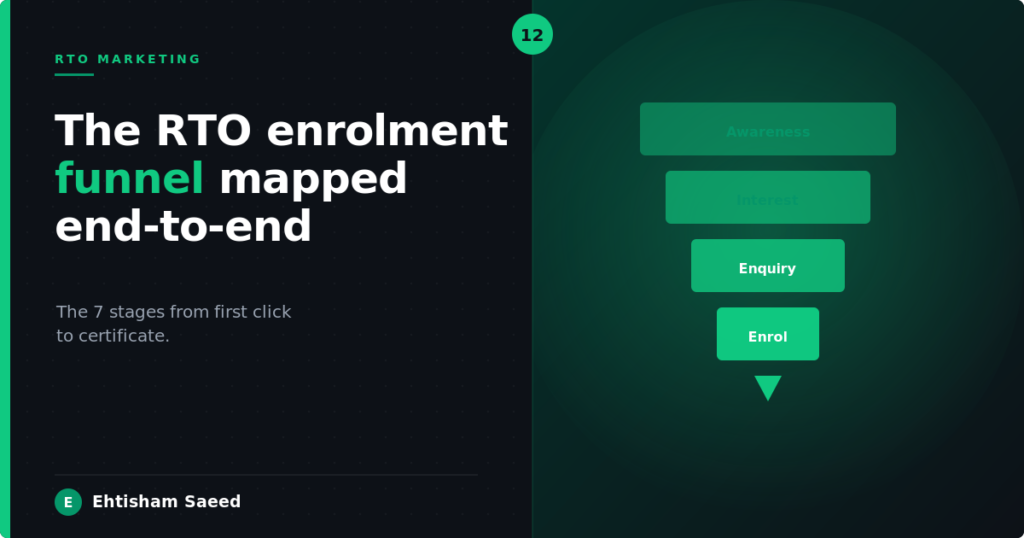
The full funnel for an Australian RTO:
- Awareness, prospect learns the RTO exists
- Consideration, prospect evaluates the qualification against alternatives
- Enquiry, prospect requests information directly
- Nurture, the RTO communicates over a 7-to-20 day decision window
- Application and pre-enrolment, prospect supplies the information needed to enrol
- Enrolment, formal acceptance, payment, and contract
- Onboarding, first 14 days of induction and first-class attendance
Each stage gets its own section below, with the typical drop-off rate, the compliance touchpoint, and the best improvement to make first.
Stage 1: Awareness
The prospect learns the RTO exists through one of several channels: Google search, Google Ads, social media, referral, employer, or training.gov.au listing.
Typical drop-off: Awareness traffic is not yet measurable as a funnel input in most RTO analytics. The relevant metric is visits to course pages with sufficient intent to consider next steps.
Compliance touchpoint: the public-facing marketing the prospect sees must satisfy the Practice Guide. Prohibited phrases, scope mismatches, and NRT logo misuse are all caught at this stage.
Best improvement to make first: the right Google Ads account structure and SEO presence for the qualifications you most want to fill.
Stage 2: Consideration
The prospect has identified your RTO as a potential option and is evaluating the qualification, the delivery mode, the cost, and the trust signals. They visit the course page. They compare you against two or three competitors.
Typical drop-off: 60 to 80 percent of consideration-stage traffic leaves without enquiring. This is the biggest single leakage point in most RTO funnels.
Compliance touchpoint: the course page must carry the mandatory information set under Outcome Standard 2.1 (total fees, refund policy, LLN requirements, support services, prerequisites, delivery mode, RPL pathway). Missing any of these costs both compliance points and conversion.
Best improvement to make first: the course page itself. Specifically, the price clarity, the trust signals, and the call to action. Among the four RTO buyer types, three drop out at consideration if pricing is hidden.
Stage 3: Enquiry
The prospect fills out a form, makes a phone call, or sends an email. They have moved from anonymous to identified. The RTO now has a name, a contact method, and a qualification of interest.
Typical drop-off: at this stage the drop-off shifts to the RTO’s response. RTOs that respond within five minutes convert at roughly twice the rate of RTOs that respond the next day.
Compliance touchpoint: the enquiry form must collect only the information the RTO is permitted to collect under the Australian Privacy Principles, with a privacy collection notice present and authorising the use the RTO intends.
Best improvement to make first: automated Email 1 of the 7-email nurture sequence firing within five minutes of submission, plus the human follow-up call within one business day.
Stage 4: Nurture
The prospect is now in the decision window. Two to six weeks typically. The seven-email nurture sequence covers this stage end-to-end, with each email serving a specific purpose at a specific moment.
Typical drop-off: with a strong nurture sequence, 35 to 55 percent of enquiries convert to enrolment. Without a sequence, the rate sits at 15 to 25 percent.
Compliance touchpoint: every email is a marketing communication subject to the Practice Guide and the Spam Act 2003. Substantiable claims, accurate scope references, compliant language, functional unsubscribe.
Best improvement to make first: the full seven-email sequence on a tested schedule, with a reply-triggered handover to human follow-up.
Stage 5: Application and Pre-Enrolment
The prospect has decided to enrol. They complete the application form, supply USI, complete the LLN and digital literacy assessment, provide any required prior qualifications evidence, and review the Student Handbook.
Typical drop-off: 10 to 25 percent of applications stall here, usually because the form is too long, the USI process is unclear, or the LLN assessment creates friction the prospect was not prepared for.
Compliance touchpoint: this is the most compliance-heavy stage. The Standards for RTOs 2025 require pre-enrolment assessment under Outcome Standard 2.2, the USI requirement is mandatory for nationally recognised training, AVETMISS data collection rules apply, and the Privacy Act governs every piece of personal information collected.
Best improvement to make first: a Student Management System that handles the application, USI verification, LLN assessment, and document collection in a single workflow. RTOGrow SMS at rtogrow.com.au covers all four in one system, AVETMISS 8.0 compliant, generating NAT00010 through NAT00130 reports as the data is collected.
Stage 6: Enrolment
The application is approved. Payment is processed. The student signs the training agreement. The enrolment is formally recorded in the SMS.
Typical drop-off: 5 to 15 percent of applications fall out between approval and payment, usually because payment fails, the payment plan terms create friction, or the student goes silent after approval.
Compliance touchpoint: the training agreement must contain all the terms the Standards require, including refund policy, complaints process, and course-specific obligations. The fee schedule must match the marketing copy that brought the student in.
Best improvement to make first: flexible payment options (deposit plus payment plan, direct debit, employer billing, funded program processing), automated payment chasing for failed transactions, and a clear next-step communication within 24 hours of enrolment.
Stage 7: Onboarding
The first 14 days of the student journey. Welcome email, login credentials, course materials, first-class attendance, first assessment introduction.
Typical drop-off: 5 to 12 percent of enrolled students fail to actually start. They paid and signed, but never logged in, never attended, never engaged. This is the most expensive drop-off because the marketing cost was already incurred.
Compliance touchpoint: Outcome Standard 2.3 covers the support that must be available to the student from enrolment. The induction must cover the student’s rights, the support services available, and the assessment expectations.
Best improvement to make first: structured first-14-days onboarding that combines automated emails, a phone or video welcome from a trainer, and a clear first-week task that creates engagement before the formal first class.
Where Most RTOs Leak Conversions
Across the funnel, four leakage points cost most Australian RTOs the bulk of their potential enrolments.
Leak 1: Consideration stage course pages with missing pricing. 60 to 80 percent of consideration traffic leaves without enquiring. Most of that leak comes from pricing being hidden behind a “request a quote” button. Among the buyer types, three of the four abandon at this point.
Leak 2: Enquiry response time over 60 minutes. RTOs that respond within five minutes convert at roughly twice the rate of RTOs that respond the next business day. The lag between Email 1 and the human call is where competitors win the enquiry.
Leak 3: Single acknowledgement email instead of full nurture sequence. The difference between 15-25 percent and 35-55 percent enquiry-to-enrolment conversion is the seven-email sequence. Most RTOs send one of the seven.
Leak 4: Application form too long. Forms that collect every piece of AVETMISS data at the enquiry stage instead of staging the collection through enquiry, application, and pre-enrolment lose 30 to 50 percent of applications. The fix is splitting the data collection across multiple steps.
How the 2025 Standards Intersect Each Stage
The 2025 Standards for RTOs apply to every stage from Awareness onward, with different specific requirements at each stage.
- Awareness and Consideration: Information and Transparency Practice Guide. All public-facing marketing must be accurate, substantiable, and aligned with scope of registration.
- Enquiry: Australian Privacy Principles and the Spam Act 2003. The collection notice and consent for follow-up must be present and accurate.
- Nurture: Information and Transparency Practice Guide plus Spam Act. Every email must satisfy both.
- Application and Pre-Enrolment: Outcome Standard 2.1 (information access) plus Outcome Standard 2.2 (pre-training assessment) plus USI requirements plus AVETMISS data rules.
- Enrolment: Training agreement must meet the Standards’ contract requirements. Fee schedule must match marketing copy.
- Onboarding: Outcome Standard 2.3 (support services) plus assessment system requirements.
An RTO that maps each stage against the relevant Standard is doing the self-assurance work the 2025 Standards expect. The funnel map and the compliance map are the same document.
Frequently Asked Questions
What conversion rate should an Australian RTO expect across the full funnel?
Awareness to course page visit: 5 to 15 percent for cold marketing. Course page visit to enquiry: 15 to 30 percent for a well-built page. Enquiry to enrolment: 35 to 55 percent with a full nurture sequence. Combined, the full marketing-to-enrolment rate sits between 0.3 and 2.5 percent of cold awareness traffic, depending on channel quality and funnel hygiene.
How long does the full funnel typically take?
From first awareness to enrolment, two to six weeks for most Certificate III and Certificate IV qualifications. Diplomas and Advanced Diplomas often take longer (six to twelve weeks) because the financial decision is bigger. Funded short courses can compress to one to two weeks because the cost barrier is lower.
Should the funnel be built inside the SMS or in a separate marketing tool?
Both work. SMS-integrated funnels (where the lead capture, nurture, and enrolment all live in one system) remove the integration burden. Separate marketing tools (CRM plus SMS connected by integration) offer more flexibility but add complexity. Most RTOs find the SMS-integrated approach simpler at scale, particularly when the SMS already handles AVETMISS reporting.
Does ASQA review the enrolment funnel during a performance assessment?
Yes, indirectly. ASQA does not assess “the funnel” as a concept, but it assesses each stage: marketing accuracy under the Practice Guide, pre-enrolment information access under Outcome Standard 2.1, pre-training assessment under Outcome Standard 2.2, training agreement quality, induction completeness. A funnel map is a useful artefact to present during a performance assessment because it shows the RTO has thought systematically about each stage.
What is the single highest-impact improvement for most RTOs?
Adding the full seven-email nurture sequence between enquiry and enrolment. Most RTOs see enquiry-to-enrolment conversion roughly double when the sequence is implemented properly, with no change to marketing spend or top-of-funnel traffic.
How often should the funnel be reviewed?
Monthly at the conversion-rate level for the active marketing periods. Quarterly at the full-funnel structural level to identify shifts in drop-off patterns. Annually at the compliance level to verify each stage still meets the current Standards and Practice Guide.
What Happens Next
The funnel map is the diagnostic tool. With each stage measured, the next month’s work focuses on the single highest-leakage stage. For most RTOs, that is either the consideration stage (course pages missing pricing) or the nurture stage (single acknowledgement instead of seven-email sequence).
Want a free compliance scan of your top-of-funnel marketing? RTO Scanner reviews your website against the prohibited phrases ASQA flags and validates your RTO code against training.gov.au in real time, free, in under five minutes. The scan identifies the awareness and consideration stage compliance leaks before they cost enrolments.
More on Enquiry to Enrolment
This guide is part of my Enquiry to Enrolment series. Read these next:
- Start here: The RTO enrolment engine
- RTO email marketing automation
- The 7-email enquiry nurture sequence
- The post-enrolment welcome sequence
Want this done for your Registered Training Organisation? See RTO marketing services.
