
Last Updated: April 2026 · By Ehtisham Saeed, RTO Marketing Specialist
Strategy without sequence is just a wishlist with a budget attached.
You just got your RTO registration approved. Or your previous marketing failed. Or you walked into a marketing manager job at an RTO that has none of this set up.
Related: RTO Case Studies
Related: How Australian RTOs Are Actually Winning in 2026
Either way, the question is the same: where do you start?
Here is the deal: most RTO marketing advice tells you what to do. Almost none of it tells you what to do first, second, third. That is the gap this guide closes.
In this post, you will get the complete framework I use with every Everyshot client. It is called The 5-Pillar RTO Marketing Method by Ehtisham Saeed. It is sequenced, ASQA-compliant by design, evergreen under the Standards for RTOs 2025, and costed across realistic Australian budgets.
Let us get into it.
Watch the 5-Minute Version of This Method
Time-poor? The 5-minute video covers the five pillars at a strategic level. Want the full build sequence with budgets, KPIs, and ASQA compliance baked in? Keep reading.
What Is an RTO Marketing Strategy and How Is It Different From RTO Marketing Tactics?
An RTO marketing strategy is the documented system that turns prospective students into enrolled students under ASQA’s marketing rules. Tactics are the individual moves inside that system. Strategy is the plan. Tactics are the chess pieces.
Most Australian RTOs jump straight to tactics. They build a website. They run Google Ads. They post on LinkedIn. None of it ties together because the strategy was never written.
A real RTO marketing strategy answers six questions before any tactic gets executed:
- Who is the student we are trying to attract?
- What does our scope of registration on training.gov.au actually let us market?
- How do we position against TAFE, Fee-Free TAFE, and other private RTOs?
- What channels will generate enquiries?
- What system converts enquiries into enrolments?
- How do we measure whether the system is working?
If your RTO cannot answer all six in writing, you do not have a strategy. You have tactics with a budget.
For a deeper definition of what RTO marketing covers, read What Is RTO Marketing first. This guide builds on that foundation.
Why Do Most Australian RTOs Need to Build a Marketing Strategy From Scratch?
Three reasons, and one of them surprises most owners.
First, the regulatory reset. The Standards for RTOs 2025 came into full effect on 1 July 2025, replacing the 2015 Standards and Clause 4.1 that governed marketing for the previous decade. Most existing RTO marketing strategies were built for the old framework. They no longer fit.
Second, the competitive reset. Fee-Free TAFE under DEWR has reshaped the price expectation in entire qualification categories. Old strategies built around price competition no longer work.
Third, the data reset that nobody talks about. NCVER data shows 925,600 students in nationally recognised qualifications January to September 2025, a 6.9 percent decline year on year for government-funded RTO enrolments. The pie is shrinking on one side and growing on the other. Strategies built for the old growth curve fail in the new one.
A from-scratch strategy is not just for new RTOs. It is for every RTO whose plan was written before 1 July 2025.
The 5-Pillar RTO Marketing Method: A Build Sequence
Here is the full framework. Each pillar has two build steps inside it, a deliverable, a budget range, and a target completion window. Skipping pillars breaks the system. Reordering them costs you time and ASQA exposure.
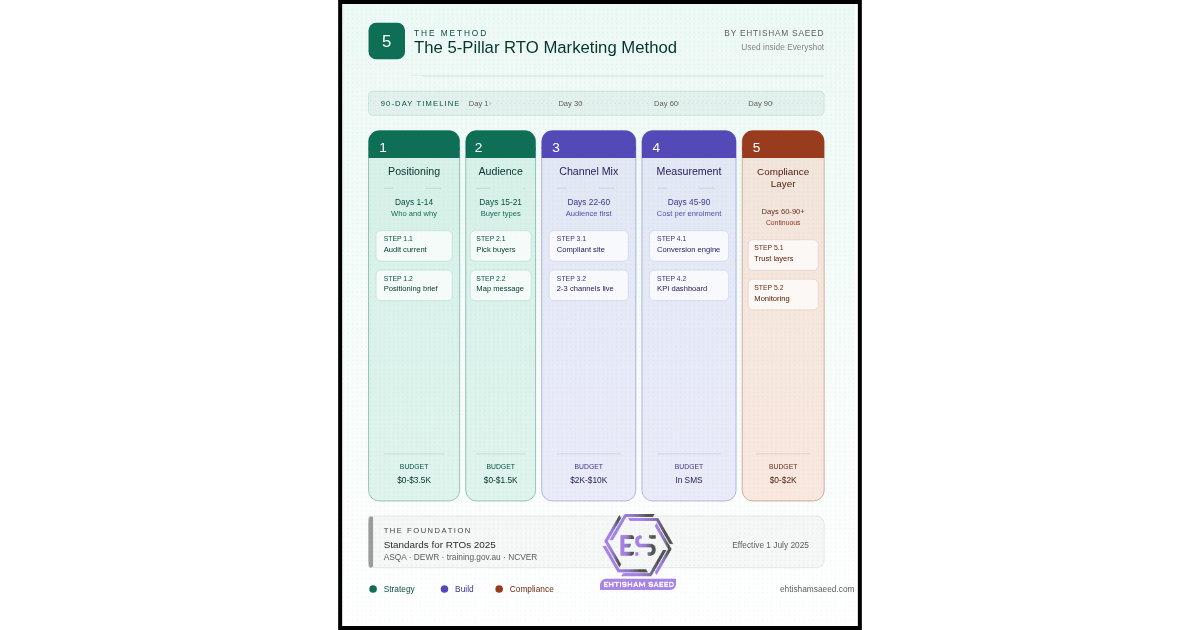
The five pillars are: Positioning, Audience, Channel Mix, Measurement, and the Compliance Layer. Together they form The 5-Pillar RTO Marketing Method by Ehtisham Saeed. You can document the strategy in a week. You build it live in 90 days. Run the pillars in order and you have a working system.
What this guide does not cover. This guide is the strategic framework. Each pillar will get its own deep-dive guide on this site over the coming months. If you want the complete pillar before the cluster pages publish, this is it.
Pillar 1: Positioning (Days 1-14)
Pillar 1 of The 5-Pillar Method answers who and why. You decide who you are trying to enrol and why they would choose your RTO over TAFE, Fee-Free TAFE, or another private RTO. Most RTOs answer the positioning question with phrases like “quality training, industry experience, friendly trainers.” Every other RTO claims those exact same three things. Generic positioning is the same as no positioning. Real positioning is narrower, defendable, and constrains every later pillar. This is the pillar almost every RTO skips. It is also the pillar that makes the next four work or fail.
The positioning test: if a competitor copies your positioning by changing two words, you do not have positioning. You have marketing copy.
A real RTO positioning statement looks like this: “We are the Certificate III in Individual Support specialist for career changers in Western Sydney.” Specific qualification. Specific demographic. Specific location. That is defendable.
The two build steps inside Pillar 1:
Step 1.1: Audit your current position (Days 1-7). You cannot build a strategy on guesses. The audit covers four artefacts: your website, your training.gov.au listing, your existing marketing materials, and your scope of registration. Use RTO Scanner for the website portion (free, scans 75-plus prohibited phrases, validates your RTO code live against training.gov.au). The deliverable is a one-page baseline document.
Step 1.2: Write your positioning brief (Days 8-14). Decide your sector specialisation, geographic focus, funded vs fee-for-service positioning, domestic vs CRICOS positioning, and your differentiation angle. The deliverable is a one-page positioning statement that passes the two-word test.
Pillar 1 deliverable: Baseline audit + one-page positioning statement
Pillar 1 budget: $0 to $3,500
Pillar 1 timing: 14 days
Pillar 2: Audience (Days 15-21)
Pillar 2 of The 5-Pillar Method narrows positioning into specific buyer types. Most RTOs assume their audience is one person. Almost every qualification has at least four buyer types, each with different objections, different decision triggers, and different places where they actually look for training. One offer. Different minds. Different decisions. If you write one message for all four, you reach none. Pillar 2 forces you to pick the one or two buyer types that fit your positioning from Pillar 1 and write everything for them. This is where positioning becomes specific enough to act on.
The 4 buyer types every Australian RTO has:
| Buyer type | Pays the fee | Primary concern | Where they are |
|---|---|---|---|
| The career changer | Self-funded | Will this actually lead to a job? | Searching Google at night |
| The upskiller | Self-funded or employer-paid | Time pressure, not ability | LinkedIn, employer-referral |
| The employer | Pays for staff | Completion rate, minimal disruption | LinkedIn, B2B referral |
| The funded student | Government subsidy | Pathway support | Inside JobActive or similar referral system |
The two build steps inside Pillar 2:
Step 2.1: Pick your priority buyer types (Days 15-18). From your positioning in Pillar 1, identify which one or two buyer types you are designing the strategy for. Do not pick all four. Picking all four is the same as picking none.
Step 2.2: Map message to buyer type (Days 19-21). For each priority buyer type, write the headline, the proof point, and the call to action that speaks to their primary concern. This becomes the source material for everything that follows.
Pillar 2 deliverable: Buyer-type cards + message-to-buyer mapping document
Pillar 2 budget: $0 to $1,500
Pillar 2 timing: 7 days
Pillar 3: Channel Mix (Days 22-60)
Pillar 3 of The 5-Pillar Method turns positioning and audience into traffic. This pillar carries two build steps because you cannot run paid or organic campaigns without an ASQA-compliant website to send the traffic to. The principle that drives this pillar is simple and almost always violated:
Audience first. Channel second. Budget third.
Most RTOs pick the channel first and try to force every buyer type into it. That never works. The career changer is on Google at night searching qualifications. The employer is on LinkedIn trusting referrals. The funded student is already inside the JobActive system. Same RTO. Same qualification. Completely different paths.
The two build steps inside Pillar 3:
Step 3.1: Build the compliance-ready foundation (Days 22-35). Your website is the most-trafficked piece of marketing real estate you own. It must display your RTO code on every course page, use the NRT logo to the Conditions of Use, avoid the 75-plus phrases ASQA considers misleading, capture USI at the enrolment form, and present LLN information before enrolment. Generic WordPress themes do not know any of this. Use Easy RTO or build custom with an ASQA-aware developer. Budget $2,000 to $8,000 setup.
Step 3.2: Activate 2-3 channels (Days 36-60). Pick the channels that match your priority buyer types from Pillar 2. Run two channels well rather than five poorly. Spreading $3,000 a month across five channels delivers nothing in any of them. Concentrating it in two delivers measurable enquiries by month three.
Channel mapping by buyer type:
| Channel | Best for | Payoff speed |
|---|---|---|
| Course page SEO | Career changer, upskiller | Slow (3-6 months) |
| Google Ads on qualification + location | Career changer | Fast (weeks) |
| LinkedIn organic + outreach | Employer, upskiller | Medium (months) |
| Employer partnership outreach | Employer, funded student | Slow (months) |
| Pathway provider partnerships | Funded student | Slow (months) |
| Email automation sequences | All four | Compounds over time |
| training.gov.au listing optimisation | All four | Foundation |
| Google Business Profile + local SEO | Career changer (local) | Medium (months) |
Pillar 3 deliverable: Live ASQA-compliant website + 2-3 active channels
Pillar 3 budget: $2,000 to $10,000 setup + $1,500 to $5,000 per month ongoing
Pillar 3 timing: 39 days
Pillar 4: Measurement (Days 45-90, Overlapping Pillar 3)
Pillar 4 of The 5-Pillar Method tracks the right number and ignores the wrong one. Most RTOs track the wrong number. Cost per lead looks like a marketing KPI. It is not. It hides the truth.
The example that proves it. Two campaigns both show $40 per lead. Identical on the dashboard. But Campaign A converts 10 percent of leads to enrolments, so each enrolled student costs $400. Campaign B converts 30 percent, so each enrolled student costs $133. Same lead cost. Triple the difference at the enrolment line. One campaign makes money. The other quietly burns it. Cost per lead does not show you that. Cost per enrolled student does.
Cost per lead won’t show you that. It hides the truth.
The two build steps inside Pillar 4:
Step 4.1: Build the conversion engine (Days 45-75). This is the documented workflow that takes an enquiry from first touch to signed enrolment, every time, the same way. It includes auto-confirmation emails, course pack delivery, LLN screening, payment options, and start date reminders. RTOGrow SMS ships with 16 pre-built email automations specifically for the RTO enrolment journey. Under the 2025 Standards, prerequisite and support service information must be communicated before enrolment, which makes the conversion workflow a compliance asset as well as a sales asset.
Step 4.2: Install the KPI dashboard (Days 76-90). Track these eight KPIs monthly:
| Funnel stage | KPI | What it tells you |
|---|---|---|
| Awareness | Website organic traffic | Is your SEO foundation working? |
| Awareness | Google Ads impressions | Is your paid reach scaling? |
| Consideration | Course page conversion rate | Are course pages converting visitors to enquiries? |
| Conversion | Cost per enquiry (CPE) | Are channels efficient at the top? |
| Conversion | Cost per enrolled student | Is the full system efficient? (the number that matters) |
| Conversion | Enquiry-to-enrolment rate | Is your conversion engine working? |
| Quality | Student completion rate | Are you attracting the right students? |
| Compliance | Monthly RTO Scanner score | Is your marketing staying compliant as it scales? |
Pillar 4 deliverable: Live conversion workflow + live KPI dashboard with monthly review
Pillar 4 budget: Built into student management system cost
Pillar 4 timing: 45 days, overlapping Pillar 3
Pillar 5: The Compliance Layer (Days 60-90 Onward)
Pillar 5 of The 5-Pillar Method is the layer that makes RTO marketing different from every other kind of marketing in Australia. Even if you nail the first four pillars, there is one layer most agencies completely ignore. The 2025 Standards took effect on 1 July 2025. Inside them is the regulatory expectation that governs every word your RTO publishes, your website, your ads, your social posts, all of it. Most agencies miss this entirely. They reuse what works for gyms or SaaS, apply it to RTOs, and hope it sticks. It does not. RTOs are not just selling. They are regulated. The Compliance Layer is what turns the first four pillars into a system that survives an ASQA performance assessment.
The two build steps inside Pillar 5:
Step 5.1: Add trust layers and demonstrable outcomes (Days 60-90). Under the 2025 Standards, demonstrable student outcomes are now both a marketing asset and a compliance asset. NCVER’s VET student outcomes 2025 report shows 89.3 percent of qualification completers were satisfied with their training and 86.7 percent achieved their main training goal. If your RTO outperforms those benchmarks, your marketing must say so. Add testimonials with documented consent, completion rates on course pages, employer partnership logos, Google Business Profile reviews, and visible Last Updated dates on course information.
Step 5.2: Set up continuous compliance monitoring (Days 75 onward). Self-assurance is now a continuous expectation under the 2025 Standards. The 2026 Annual Declaration on Compliance is the first full reporting cycle under the new framework, and the CEO must declare the RTO has monitored its own compliance. That declaration is impossible to make truthfully without a continuous monitoring system. Run RTO Scanner monthly. Document the results. Treat compliance as a marketing KPI from day one.
Pillar 5 deliverable: Trust signals visible across the website + monthly compliance audit cadence
Pillar 5 budget: $0 to $2,000 setup + $0 to $200 per month ongoing
Pillar 5 timing: Ongoing from Day 60
How Much Should an Australian RTO Spend on a Marketing Strategy?
Total cost varies by ambition, scope, and existing assets. Here is the realistic Australian range across the 5-pillar build:
| Pillar | Setup cost (one-time) | Ongoing (monthly) |
|---|---|---|
| Pillar 1: Positioning | $0 to $3,500 | $0 |
| Pillar 2: Audience | $0 to $1,500 | $0 |
| Pillar 3: Channel Mix (website + channels) | $2,000 to $10,000 | $1,500 to $5,000 |
| Pillar 4: Measurement (SMS + dashboard) | $500 to $2,000 | $200 to $1,000 |
| Pillar 5: Compliance Layer | $0 to $2,000 | $0 to $200 |
| Total | $2,500 to $19,000 | $1,700 to $6,200 |
Realistic launch budget for most Australian RTOs: $5,000 to $25,000 setup + $2,000 to $8,000 per month ongoing. Below $5,000 setup, you are cutting corners that will cost more later. Above $25,000, you are paying agency markup not specialist value.
Below $5,000 setup, you are cutting corners that will cost more later.
Why Do Most RTO Marketing Strategies Fail in the First 6 Months?
Five failure patterns account for almost every RTO marketing strategy that collapses in its first six months. Knowing them in advance is the cheapest insurance you can buy.
Failure 1: Tactics before strategy. RTOs run Google Ads, build a website, post on LinkedIn, and never write down who they are targeting or why. Every tactic produces something. Nothing connects.
Failure 2: Generic agency that does not know ASQA. Most marketing agencies in Australia have never read the Standards for RTOs 2025. They build campaigns that generate enquiries and compliance findings at the same time. The savings from a generic agency are usually paid back to ASQA in audit remediation costs.
Failure 3: Skipping Pillar 1. You cannot fix what you cannot see. RTOs that skip the audit are building strategies on assumptions. The first ASQA audit reveals all the assumptions that were wrong.
Failure 4: Setup budget without ongoing budget. RTOs spend $15,000 building a beautiful website and budget $0 per month to drive traffic to it. The website becomes a $15,000 brochure that nobody reads.
Failure 5: No measurement, no course correction. Without Pillar 4 KPIs, every decision after launch is a guess. By the time you realise the strategy is failing, you have burned 6-12 months of budget.
Generic agencies see the funnel. Specialist RTO marketing accounts for the cage.
How Do the Standards for RTOs 2025 Change Strategy Building for RTOs?
The Standards for RTOs 2025 came into full effect on 1 July 2025. They are the most significant regulatory change Australian VET has seen in a decade. For marketing strategy, three things changed.
Change 1: Outcome-focused replaces process-focused. The old 2015 Standards asked whether you had a marketing review policy. The 2025 Standards ask whether your marketing accurately reflects student outcomes. That is a higher bar to clear and a different evidence trail to build.
Change 2: Self-assurance replaces reactive compliance. RTOs must now actively monitor their own marketing compliance. The 2026 Annual Declaration on Compliance is the first full reporting cycle under the new framework. The CEO must declare the RTO has monitored its own compliance against the 2025 Standards. That declaration is impossible to make truthfully without continuous monitoring. Pillar 5 of the Method is built around this requirement.
Change 3: Demonstrable student outcomes become marketing assets. Completion rates, satisfaction scores, and employment outcomes were always good marketing. Under the 2025 Standards they are also compliance evidence. Every Pillar 5 trust layer now does double duty.
The implication: compliance and marketing are no longer separate disciplines with separate budgets. The 5-Pillar Method treats them as one system because the 2025 Standards already do.
Should You Build Your RTO Marketing Strategy In-House or Hire a Specialist?
Three options, three trade-offs. The right answer depends on your time, technical confidence, and ASQA risk tolerance.
| Approach | Setup time | Cost (year 1) | ASQA risk | Best for |
|---|---|---|---|---|
| DIY in-house | 90-180 days | $5,000-$15,000 | Medium-High | Tech-confident founders with marketing background |
| Generic marketing agency | 60-120 days | $25,000-$60,000 | High | Brand-focused RTOs in non-ASQA-sensitive sectors (rare) |
| Specialist RTO agency (Everyshot) | 30-90 days | $20,000-$80,000 | Low | Most Australian RTOs |
The generic agency middle ground is almost always the worst value. You pay agency rates without buying specialist knowledge. The two viable paths are aggressive DIY using the 5-Pillar Method in this guide, or hiring a specialist who has built this system before.
If you want a specialist to run The 5-Pillar Method for your RTO, our RTO marketing strategy service runs the full build in 60-90 days with ASQA compliance baked in.
Frequently Asked Questions About RTO Marketing Strategy
How long does it take to build an RTO marketing strategy from scratch?
You can document the strategy in a week and build it live in 60 to 90 days using The 5-Pillar Method. Pillar 1 (Positioning) takes 14 days. Pillar 2 (Audience) takes 7 days. Pillar 3 (Channel Mix) takes 39 days including the compliant website build. Pillar 4 (Measurement) and Pillar 5 (Compliance Layer) overlap with Pillar 3 and run continuously after launch. Skipping pillars compresses the timeline but breaks the system. Doing it right the first time is faster than doing it twice.
How much does it cost to build an RTO marketing strategy in Australia?
Setup costs typically run $5,000 to $25,000 for the full 5-Pillar build. Ongoing spend ranges from $2,000 to $8,000 per month depending on lead generation budget and student management software. Below $5,000 setup, you are cutting corners that increase compliance risk and reduce conversion. Above $25,000, you are paying agency markup not specialist value. The lowest-cost path uses tools like Easy RTO for website and RTOGrow SMS for student management to keep setup under $10,000.
What is the difference between RTO marketing strategy and RTO marketing tactics?
Strategy is the documented system that turns prospective students into enrolled students. Tactics are individual moves inside that system. Strategy answers who you are targeting, why they choose you, what channels you use, and how you measure success. Tactics are running Google Ads, posting on LinkedIn, sending email sequences. Most RTOs jump to tactics without strategy and wonder why nothing connects. A strategy is written, sequenced, and measurable. Tactics are activities. You need both, but strategy comes first.
Do I need a marketing strategy if I already have an RTO website?
Yes. A website is one part of Pillar 3, not a strategy. Most RTO websites built without a strategy are missing the structural elements that make them convert: positioning, course page architecture, conversion workflow, and compliance monitoring. The 5-Pillar Method treats your existing website as a Step 3.1 deliverable that can be audited (Pillar 1) and improved or rebuilt as needed. Roughly 8 in 10 RTO websites we audit with RTO Scanner need significant changes to function inside a real strategy.
Can I build an RTO marketing strategy without a marketing background?
Yes, but expect the build to take 120-180 days instead of 60-90, and budget for at least one specialist consultation per pillar. The 5-Pillar Method is buildable by a non-marketer who is willing to follow the sequence and use specialist tools at the right moments. The pillars that most need specialist input are Pillar 1 (positioning) and Pillar 3 (channel mix). The pillars most buildable solo are Pillar 4 (measurement) and Pillar 5 (compliance layer monitoring).
How do the Standards for RTOs 2025 change my marketing strategy?
The Standards for RTOs 2025 shift the regulatory bar from process compliance to outcome-focused compliance. Your marketing must now accurately reflect demonstrable student outcomes, not just describe your courses. Self-assurance is now a continuous expectation, which means the Pillar 5 Compliance Layer is no longer optional. The 2026 Annual Declaration on Compliance is the first full reporting cycle under the new framework, and the CEO must declare compliance against the 2025 Standards specifically.
What KPIs should I track for my RTO marketing strategy?
Track eight KPIs monthly: website organic traffic, Google Ads impressions, course page conversion rate, cost per enquiry, cost per enrolled student, enquiry-to-enrolment rate, student completion rate, and your monthly RTO Scanner compliance score. The most important number is cost per enrolled student, not cost per lead. Cost per lead hides the truth because two campaigns can produce $40 leads and wildly different cost per enrolment outcomes. The Scanner score is the KPI almost no other RTO marketing guide tracks, but under the 2025 Standards it sits inside continuous compliance expectations.
Do I need different strategies for domestic vs international (CRICOS) students?
Yes. CRICOS-registered RTOs must comply with both the Standards for RTOs 2025 under ASQA and the ESOS Act and National Code under the Department of Education. The 5-Pillar Method still applies, but Pillar 1 (Positioning) and Pillar 3 (Channel Mix) need parallel tracks for domestic and international. International student marketing has stricter rules around course duration claims, agent agreements, and approval pathways. ASQA flagged international student marketing as a critical risk priority for 2026, so CRICOS providers carry additional compliance load that must be designed into the strategy.
How often should I update my RTO marketing strategy?
Run a full strategy review quarterly. Run a compliance audit monthly using RTO Scanner. Run a complete from-scratch rebuild only when major regulatory changes happen, like the move from the 2015 Standards to the 2025 Standards on 1 July 2025. The 5-Pillar Method is designed to be updated continuously inside Pillar 5, not torn down and rebuilt. RTOs that follow the quarterly review cadence outperform RTOs that set and forget by margins that compound across years.
What tools do I need to execute an RTO marketing strategy?
Four tool categories: a compliant website platform like Easy RTO, a student management system like RTOGrow SMS for AVETMISS-compliant data and email automation, a continuous compliance monitor like RTO Scanner, and a course delivery system like Expertle if you deliver online or blended training. Generic equivalents exist for each but typically need significant configuration to work inside ASQA-compliant flows. Purpose-built RTO tools save 60-100 hours of setup time across the 5-Pillar build.
Where to Go From Here
That is The 5-Pillar RTO Marketing Method. Five pillars. Document in a week, build in ninety days. One sequenced system that turns scattered tactics into a buildable strategy under the Standards for RTOs 2025.
Here is the question to sit with. Which pillar is your RTO weakest at right now, the Pillar 1 positioning baseline or the Pillar 5 compliance layer?
If you are not sure where you stand, run a free scan at rtoscanner.ehtishamsaeed.com. It is the Pillar 1 audit tool, free, no signup, scored PDF report in under five minutes. Or if you want a specialist to run the 5-Pillar build for you, book a free 30-minute strategy call and we will map out exactly what your Method needs to look like.