
Last Updated: May 2026 · By Ehtisham Saeed, RTO Marketing Specialist
AI will write your RTO a “guaranteed job” headline without blinking. The value of AI in RTO marketing is entirely in the workflow you wrap around it.
Most advice on using AI for marketing is written for businesses with no compliance constraints. An RTO is not one of those businesses. Every piece of published marketing is a claim governed by the Standards for RTOs 2025, and AI tools, trained on the open internet, will cheerfully reproduce exactly the exaggerated, unsubstantiated language that ASQA flags. Used carelessly, AI does not just risk a weak post; it risks a compliance finding at scale.
Used well, though, AI is one of the highest-value tools an RTO marketing function has. This guide covers how to use it to produce compliant content, the workflow that keeps it safe, and the newer reason RTOs need to be AI-aware in the first place. It connects the AI for RTO operations cluster to the marketing work, sitting alongside the 90-day AI adoption plan and the AI use policy.
Why RTO Marketing Is a High-Value, High-Risk AI Use Case
Marketing is usually the first place an RTO applies AI, and for good reason, but it carries a specific risk profile.
For a beginner: AI writing tools can draft blog posts, social media captions, course descriptions, and emails in seconds. For a small RTO marketing team, that is a large time saving, which is why it is the most common starting point for AI adoption.
For an intermediate operator: marketing is the ideal first AI use case because the input data is public (course information, career outcomes, qualification details), the output is reviewable before it goes anywhere, and the productivity gain is measurable. The 90-day adoption plan recommends it as the first pilot for exactly these reasons.
For a compliance manager: marketing is also where AI can create compliance risk fastest, because the output is published externally and is directly subject to the Information and Transparency Practice Guide. An AI tool does not know that “guaranteed job” breaches the Practice Guide, that “fully accredited” should be “nationally recognised”, or that a qualification code must be current on your scope of registration. It will produce all of these confidently. The risk is not the tool; it is publishing the tool’s output without review.
What AI Is Genuinely Good At (and Bad At) for RTO Marketing
Using AI well starts with knowing where it helps and where it does not.
AI is genuinely good at:
- First drafts of blog posts, course pages, and email sequences that a human then edits
- Structuring content (outlines, headings, logical flow)
- Summarising long source material into marketing-friendly language
- Generating variations (multiple subject lines, headline options, calls to action)
- Reformatting content for different channels (turning a blog post into social posts)
AI is unreliable at:
- Knowing what is compliant under the Practice Guide (it will generate prohibited claims)
- Verifying that a qualification code is current on your scope of registration
- Substantiating outcome statistics (it may invent plausible-sounding numbers)
- Distinguishing nationally recognised training from accredited or non-accredited language
- Understanding the specific consequences of a claim for your RTO
The pattern is clear: AI accelerates the production work and is unreliable on the compliance judgement. That split is exactly why the workflow matters.
The Compliant AI Marketing Workflow
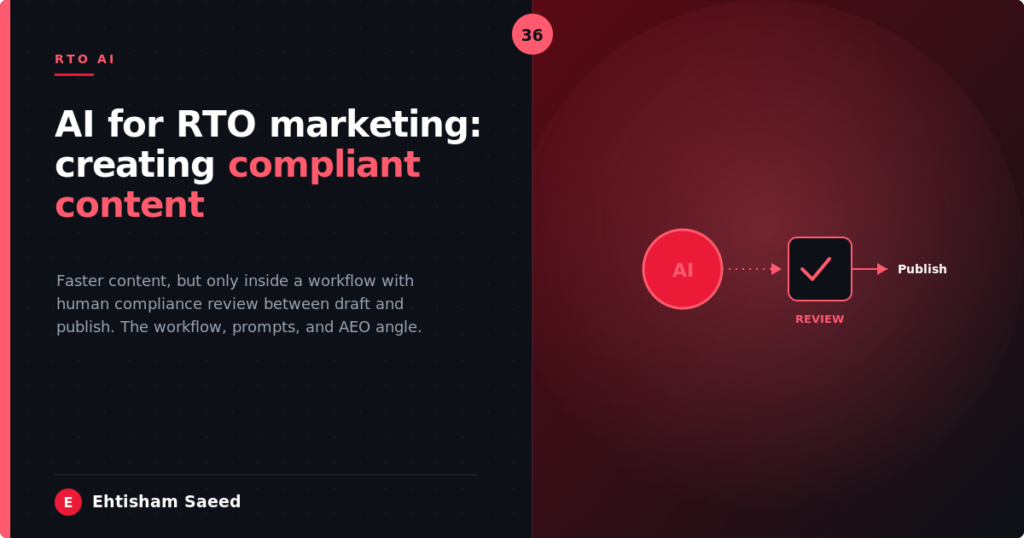
The whole safety of AI in RTO marketing comes down to one workflow with a non-negotiable review gate in the middle. Four steps.
- Prompt for a first draft. Give the AI tool the qualification details, the audience, the channel, and the key points. Treat the output as a first draft, never a finished piece.
- Review every claim. This is the gate. Check the draft against the prohibited phrases and the Practice Guide. Flag any outcome claim, any guarantee, any “accredited” language, any qualification code.
- Verify and correct. Confirm any qualification code is current on your scope at training.gov.au, replace non-compliant language, and either substantiate or remove any statistic.
- Publish and log. Publish the corrected version, and record that the AI-assisted content was compliance-reviewed, which is the audit trail your AI use policy requires.
The review gate is where compliance lives. Skip it and AI becomes a way to publish breaches faster. Keep it and AI becomes a genuine productivity gain with no added compliance risk. The gate does not need to be slow; for most marketing content it adds a few minutes, far less than the time AI saved on the draft.
How to Prompt AI for Closer-to-Compliant First Drafts
You cannot prompt your way to guaranteed compliance, the review gate is still essential, but you can prompt so the first draft is closer to compliant and the review is faster.
Three prompt habits that help:
First, tell the AI the constraints up front. Include in the prompt that the content is for an Australian RTO, that it must not promise employment outcomes, that it must use “nationally recognised” rather than “accredited”, and that it must not use guarantee language. The output will still need checking, but it will start closer to the line.
Second, give it the real, substantiated facts to work from. If you want an outcome statistic in the content, provide the actual sourced figure in the prompt rather than letting the AI invent one. AI invents plausible numbers when not given real ones, and an invented statistic is both a compliance and a credibility problem.
Third, ask it to flag its own claims. A prompt like “list any claims in this draft that would need substantiation” turns the AI into a first-pass checker, surfacing the lines your human review should focus on. It is not a substitute for the review, but it speeds it up.
The Human Review Gate Is Non-Negotiable
Every credible approach to AI in a regulated sector keeps a human accountable for the output, and RTO marketing is no exception.
The review gate is owned by whoever holds marketing compliance responsibility in your RTO. Their job at the gate is specific: confirm no prohibited phrases, no unsubstantiated outcome claims, no guarantee language, correct “nationally recognised” terminology, and a current qualification code. This is the same review that should apply to human-written marketing; AI does not change the standard, it just changes how fast the drafts arrive at the gate.
This mirrors the position ASQA takes across AI use generally, that a human remains accountable for outputs, and it is the marketing application of the human-validation requirement in your AI use policy. For the specific case of Google Ads, the same gate applies to ad copy, covered in the compliant ad copy guide.
The New Angle: Students Now Use AI to Find Courses
There is a second, newer reason RTOs need to be AI-aware in their marketing, and it is about being found, not just about producing content.
Prospective students are increasingly using AI tools to research their options. Nearly 79% of Australian students were generative AI users in 2025, and a growing share research courses through AI before they ever reach a Google search or a course page. The University of New England has gone as far as piloting ads inside ChatGPT conversations, the first Australian education provider to do so, precisely because student behaviour is shifting toward AI-mediated discovery.
For an RTO, this means marketing content increasingly needs to be readable and citable by AI, not only ranked by Google. This is the discipline often called answer engine optimisation or generative engine optimisation: structuring content with clear, direct answers, named entities, and factual statements that an AI tool can extract and cite when a prospective student asks it about a qualification or a career pathway. The practical implications, clear question-and-answer structure, specific factual claims, and named sources, are the same content habits that serve human readers well, so the two goals reinforce each other rather than competing.
Where This Fits in Your AI Use Policy
AI marketing is not a separate governance question; it is one application of the policy you should already have.
The AI use policy should cover marketing explicitly: marketing content is a green-data task (the inputs are public), the approved tools are named, the human review gate is the marketing application of the validation requirement, and the audit trail records that AI-assisted content was compliance-reviewed. One specific prohibition matters here: student personal information must never be entered into a marketing AI tool, even though marketing feels low-risk, because a testimonial workflow or a case-study draft can accidentally pull in a real student’s details. The data classification rule applies to marketing the same as everywhere else.
Five AI Marketing Mistakes That Create Compliance Risk
The patterns that turn an AI productivity gain into a compliance liability:
- Publishing without the review gate. The single biggest risk. AI output goes live without anyone checking it against the Practice Guide, and prohibited claims get published at speed.
- Trusting AI-generated statistics. The tool invents a plausible outcome figure, nobody checks it, and the RTO publishes an unsubstantiated claim. Always supply real, sourced numbers.
- Letting AI use “accredited” language. AI defaults to common usage, which often means the wrong term. “Nationally recognised” is the correct language, and the review must catch every instance.
- Putting student data into a marketing tool. A testimonial or case-study workflow pulls a real student’s personal information into an AI tool, breaching the data classification rule and potentially the Privacy Act.
- Ignoring scope of registration. AI writes about a qualification using a superseded code, and nobody checks it against the current scope, creating both wasted content and a transparency risk.
Every one of these is prevented by the same thing: the human review gate between draft and publish.
AI Personalisation Risks: Privacy, Consent, and the M Penalty
AI personalisation operates in privacy law territory. The Privacy Act 1988 reforms that took effect in June 2025 transformed the penalty landscape. RTOs running AI-personalised marketing without a privacy framework face the highest dollar exposure of any AI use category.
The New Privacy Penalty Regime
From June 2025, the Privacy Act 1988 reforms introduced direct rights of action for individuals. Previously, the Office of the Australian Information Commissioner (OAIC) was the primary enforcement path. Now individuals can sue an RTO directly in court for privacy breaches without proving financial damage.
Serious privacy breaches attract penalties up to $50 million per incident, or 30 percent of annual turnover, or three times the benefit obtained from the breach, whichever is greater. The penalty regime applies to organisations of all sizes. A small RTO faces the same maximum exposure as a large one.
AI personalisation triggers privacy obligations because it always involves personal information processing. Targeting an ad to a 35-year-old woman in Brisbane interested in aged care training requires processing personal information about that person’s age, gender, location, and interests. The legal question is whether the RTO has lawful authority to process this information.
The Australian Privacy Principles Applied to AI Marketing
Thirteen Australian Privacy Principles apply. The most relevant for AI personalisation in RTO marketing.
APP 1 (open and transparent management of personal information). Your RTO needs a privacy policy that explicitly describes AI use in marketing. Most RTO privacy policies do not currently address this. The full APP guidance from the Office of the Australian Information Commissioner is at oaic.gov.au.
APP 3 (collection of solicited personal information). You can only collect personal information that is reasonably necessary for your functions. AI personalisation that collects extensive data for fine-tuned targeting may exceed the necessity threshold.
APP 6 (use or disclosure of personal information). Personal information can only be used for the primary purpose of collection or a permitted secondary purpose. Using enrolment enquiry data to train AI models for marketing is a secondary purpose that often requires additional consent.
APP 8 (cross-border disclosure of personal information). If your AI tool processes data outside Australia (most consumer AI tools do), you remain accountable for the overseas recipient’s handling of the data. The legal liability does not transfer to the AI vendor.
APP 11 (security of personal information). Personal information uploaded to AI tools must be protected. Uploading student records into ChatGPT to draft personalised emails creates a security breach if the AI tool retains or trains on the data.
The Consumer AI Tools Problem
Most RTOs using AI in marketing are using consumer-grade tools: ChatGPT (the free or Plus version), Claude (basic version), DALL-E, Midjourney. These tools have different data handling profiles than enterprise versions.
Consumer AI tools typically retain input data and may use it for model training. Uploading student information, internal compliance data, or commercially sensitive marketing strategy to a consumer AI tool creates direct exposure. The data leaves your control. You cannot guarantee how it will be used.
The Smart and Safe RTO guidance is clear. Generic prompts using anonymised inputs are acceptable: “write a professional email template for course enquiry follow-up”. Specific prompts using personal information are not: “write a follow-up to Sarah Thompson, mobile 0412345678, who enquired about CHC33021 on 5 May”.
Enterprise-licensed AI tools (Microsoft Copilot with enterprise data protection, Grammarly Business, dedicated educational AI platforms) typically provide contractual data protections including no model training on customer data and Australian or controlled data residency. The compliance posture is significantly stronger.
The Disclosure Question
The Australian Framework for Generative AI in Schools includes transparency as one of its six principles. RTOs adopting equivalent principles need to consider when AI use should be disclosed to prospective students.
The current regulatory position is that disclosure is not yet mandatory for AI-generated marketing content. Future Practice Guide revisions may change this. Current best practice:
Disclose AI use where consumers would expect to see human authorship. Testimonials are an obvious case: if a testimonial is AI-generated rather than from a real student, this needs to be disclosed or the testimonial removed entirely. Student photos in marketing are another case: if an image is AI-generated rather than a real graduate, this needs to be transparent.
Do not disclose AI use where consumers would not reasonably expect specific human authorship. Generic blog posts, FAQ content, and template emails do not need AI disclosure under current Australian law, provided the content is accurate.
The ACL Question: AI Does Not Excuse Misleading Conduct
The Australian Consumer Law applies to AI-generated marketing content the same way it applies to human-written content. AI is not a legal shield. AI is not a defence. Misleading content is misleading regardless of how it was produced.
The Two ACL Provisions That Matter Most
Section 18 of the Australian Consumer Law prohibits misleading or deceptive conduct in trade or commerce. The provision is technology-neutral. AI-generated marketing that creates a misleading impression breaches section 18 regardless of the production method.
Section 29 of the Australian Consumer Law prohibits false or misleading representations about goods or services. The provision covers specific claim categories: testimonials, characteristics, quality, sponsorship or approval, price, and standards. AI-generated content that makes false representations in any of these categories breaches section 29.
The ACCC has prosecuted RTOs under both sections. Penalties can reach $50 million per breach for a corporation, or three times the benefit obtained, or 30 percent of annual turnover, whichever is greater. Section 18 in particular has the broadest scope because it does not require intent to mislead. The conduct itself is the breach.
AI-Specific ACL Risks
The disclosure question. AI use does not need to be disclosed in most marketing contexts. But the absence of disclosure cannot itself be misleading. If a testimonial is AI-generated and presented in a way that creates the impression a real student authored it, the missing disclosure becomes part of the misleading conduct.
The fabricated testimonial issue. AI-generated testimonials present as endorsements when no real endorser exists. Section 29(1)(e) explicitly prohibits false representations about endorsements. Fabricated AI testimonials are a clear breach. Removing them is the only safe path.
The synthesised graduate problem. AI-generated images of graduates presented as evidence of student outcomes create a false impression of an authentic graduate community. Section 29(1)(b) prohibits false representations about the standard or quality of services. Implying a graduate base that does not exist is a false representation about quality.
The deepfake risk. AI tools can now generate realistic video and voice content. RTOs that use deepfake-style imagery (a “happy graduate” video where the graduate is AI-generated) attract the same misleading conduct risks as fabricated testimonials. The technology is more sophisticated. The compliance principle is the same.
The Consumer Perception Test
The ACL test is consumer perception. Would a reasonable consumer be misled by the AI-generated content? The question is not whether the content is technically true. The question is whether the content creates an impression that turns out to be false.
AI image showing a state-of-the-art lab when the actual lab is basic: misleading impression about facilities. AI testimonial reading “great course, got a job in two weeks” when no such student exists: misleading impression about employment outcomes. AI-generated case study describing a fictional career success: misleading impression about typical results.
The framework recommendation: every AI-generated marketing asset gets reviewed against the consumer perception test. What impression does this create. Is the impression accurate. Can the impression be supported with evidence. If any of the three answers is uncertain, the asset is unsafe.
Frequently Asked Questions
Can an RTO use AI to write its marketing content?
Yes, within a workflow that keeps a human compliance review between the AI draft and publication. AI is well suited to first drafts, structure, and idea generation. It is unreliable on the compliance judgement that VET marketing requires, so every AI-assisted piece must be reviewed against the Practice Guide and prohibited phrases before it goes live.
Will AI-written marketing get my RTO in trouble with ASQA?
Only if it is published without compliance review. ASQA assesses the published marketing, not the tool that drafted it. AI-drafted content that is human-reviewed against the Practice Guide before publishing is treated the same as human-written content. AI-drafted content published unchecked carries the same risk as any non-compliant marketing. Our guide to whether ASQA penalises AI use covers this in full.
Why does AI keep writing non-compliant claims?
Because AI tools are trained on the open internet, where exaggerated education marketing is common. The tool reproduces the patterns it has seen, including “guaranteed job” and “fully accredited”, without knowing they breach the Practice Guide. Telling the AI the constraints up front reduces this, but the human review gate is still essential.
Which AI tool is best for RTO marketing content?
The tools differ in writing quality and compliance-friendliness. The Claude vs ChatGPT vs Gemini for RTOs comparison covers the differences in detail. Whichever tool you choose must be on an enterprise or pro tier that does not train on your input, and named as approved in your AI use policy.
Do students really use AI to find courses?
Increasingly, yes. Nearly 79% of Australian students were generative AI users in 2025, and a growing share research courses through AI tools before traditional search. Some education providers have begun advertising inside AI platforms. This means RTO content benefits from being structured so AI tools can read and cite it, not just ranked by Google.
Can I use AI to write student testimonials or case studies?
You can use AI to draft and structure them, but never enter a real student’s personal information into the tool, and never fabricate a testimonial. A genuine testimonial with documented consent can be edited for clarity with AI using only the parts the student approved; an invented testimonial is both a Practice Guide and an Australian Consumer Law problem.
What Happens Next
AI in RTO marketing is a strong productivity gain once the review gate is in place. The governance sits in your AI use policy, the rollout sequence is in the 90-day AI adoption plan, the tool choice is in the Claude vs ChatGPT vs Gemini comparison, and the broader question of whether ASQA penalises AI use is answered in our guide to ASQA and AI. For the marketing language itself, the prohibited phrases guide is the reference your review gate runs against, and for paid search specifically, the compliant ad copy guide applies the same gate to Google Ads.
Want to check whether your current marketing, AI-assisted or not, would pass a Practice Guide review? RTO Scanner reviews your website copy against the phrases ASQA flags and validates your RTO code against training.gov.au in real time, free, in under five minutes.
More on RTO Marketing Compliance
This guide is part of my RTO Marketing Compliance series. Read these next:
- Start here: The RTO marketing compliance guide
- The Information and Transparency Practice Guide
- RTO marketing prohibited phrases
- Third-party marketing arrangements
Want this done for your Registered Training Organisation? See compliant RTO website design.